Showing posts with label Animation. Show all posts

Thursday, November 18, 2010

batman the animated 1992


Batman: The Animated Series, originally known as simply Batman, is an American animated series adaptation of the comic book series starring the DC Comics superhero, Batman. The series is noted for being the first to take place in the DC Animated Universe. It was produced by Warner Bros. Animation.

The visual style of the series is based on the artwork of producer Bruce Timm. The original series aired on Fox from September 5, 1992 to September 15, 1995. When the first season of the series aired on weekday afternoons, it lacked an on-screen title, and was referred to as only Batman in open narration for the second half of a two-part episode ("Previously on Batman..."). When its timeslot was moved to weekends (on some Fox channels) for the second season, it was given the on-screen title The Adventures of Batman & Robin.In a list of the 25 greatest animated shows of all time, TV Guide placed Batman as 12th.


Development

The original series was partially inspired by the Frank Miller comic Batman: The Dark Knight Returns, the Tim Burton films Batman and Batman Returns, and the acclaimed Superman cartoons produced by Fleischer Studios in the 1940s. Bruce Timm and Eric Radomski designed the series by closely emulating the Tim Burton films' "otherworldly timelessness," incorporating period features such as black-and-white title cards, police blimps (even though no such thing has existed, Timm has stated he found it to fit the period they were going for), 40s influenced look and a "vintage" color scheme in a largely film noir-influenced style. The series initially took a variation of music written by Danny Elfman for the Burton films Batman and Batman Returns as its theme; later episodes of the series used a new theme with a similar style by Shirley Walker (who was occasionally Elfman's conductor on the films they worked on). The score of the series was influenced by Elfman and Walker's work on Batman and Batman Returns and the music of 40s film noir. The other major element inspired by the 1989 film is the series interpretation of the Joker character as half way between psychotic killer and prankster clown versions of the comic book character. His real name in the series, like the film, is given several times as Jack Napier, although it is later suggested that it is simply his primary alias.
Batman, as depicted in the series.

The program was much more adult-oriented than some previous typical superhero cartoon series. It was the first such cartoon in years to depict firearms being fired instead of laser guns (only one person has ever been actually depicted as shot; Commissioner Gordon in the episode "I Am the Night" was seen to have a gunshot wound after the firefight was finished), Batman actually punching and kicking the antagonists, as well as the existence of blood; in addition, many of the series' backgrounds were painted on black paper. The distinctive visual combination of film noir imagery and Art Deco designs with a very dark color scheme was called "Dark Deco" by the producers. First-time producers Timm and Radomski reportedly encountered resistance from studio executives, but the success of Burton's first film allowed the embryonic series to survive long enough to produce a pilot episode, "On Leather Wings", which according to Timm "got a lot of people off our backs."[8]

The series received critical acclaim for its distinctive animation and mature writing. Fans of a wide age range praised the show's sophisticated, cinematic tone and psychological stories. Voice-actor Kevin Conroy used two distinct voices to portray Bruce Wayne and Batman, as Michael Keaton and Christian Bale have done in the live-action films. The series was also notable for its supporting cast that included major actors performing the voices of the various classic villains, most notably Mark Hamill, who defined a whole new career for himself in animation[10] with his cheerfully deranged portrayal of the Joker. The voice recording sessions were recorded with the actors together in a studio, like a radio play, unlike most animated films, in which the principal voice actors record separately and never meet (various interviews have noted that such an arrangement (having the cast record together) was a benefit to the show as a whole, as the actors were able to 'react' to one another, rather than simply 'reading the words'). This method would later be employed for all subsequent animated series in the DC Animated Universe.

The key to the series' artistic success is that it managed to redefine classic characters, paying homage to their previous portrayals while giving them each a new dramatic force. The characterization of villains such as Two-Face, Poison Ivy, and the Riddler as well as heroes like Gordon and Robin demonstrate this. One of the series' most famous innovations was the Joker's assistant, Harley Quinn, who gained such popularity that DC Comics later added her to the mainstream Batman comic book continuity. The Penguin also underwent change for the series. His appearance was remodeled after the version seen in Batman Returns, which was being released at the same time as the series. New life was additionally given to nearly forgotten characters for the series such as the Clock King. In addition, dramatic changes were made to villains such as Clayface and Mr. Freeze. With the help of the series, the character of Mr. Freeze was turned around from a clichéd mad scientist with a gimmick for cold to a tragic figure whose frigid exterior hides a doomed love and vindictive fury. Part of this tragedy aspect of Mr. Freeze was later mimicked throughout the story-line of Joel Schumacher's infamous movie Batman & Robin, although much of the film's drama was lost with the resurrection of the pun-quipping mad scientist image.

Information from Wikipedia, the free encyclopedia

Friday, November 12, 2010

Batman Beyond 1999


Batman Beyond, also known as Batman of the Future, is an Emmy Award-winning American animated television series created by The WB Television Network in collaboration with DC Comics and Warner Bros. Animation as a continuation of the Batman legacy. It began airing on January 10, 1999, and ended its run on December 18, 2001. After 52 episodes spanning three seasons and one direct-to-video film, the series was put on hold for the new Justice League animated series despite the network having announced plans for a fourth season. However, there was a short-lived spin-off, The Zeta Project. In The Zeta Project's first season episode "Shadows", there is a crossover with Batman Beyond; in this continuity, the story takes place between the episode "Countdown" and the series finale "Unmasked."

Batman Beyond is set in the chronological future of the DC animated universe, although it was released before Justice League, Justice League Unlimited, and Static Shock. Some characters from the series appeared two years later in "Future Shock", an episode of Static Shock, and then again in "The Once and Future Thing", episodes of Justice League Unlimited. The character of Terry McGinnis was revisited a final time in the JLU episode "Epilogue", which tells much about the future of Batman.

Batman Beyond is said to exploit the darker side of many Batman projects, playing on key elements such as emotions, personal relations, the fear of the unknown and technological malfunctions. As such, it was considerably darker than most other children's programs at the time, although producer Bruce Timm recalls it was conceived as a kid-friendly Batman cartoon. It is also the first Batman series to portray the hero as a teenager. IGN named the show 40th on their list of "Top 100 Animated TV Series".

Batman Beyond will be shown on The Hub network in the Fall 2010 season. The show is currently airing on the UK channel Kix! under the title of Batman of the Future.


Story

The pilot episode begins in 2019, where an aging Batman, equipped with a high-tech Batsuit, takes on the kidnappers of Bunny Vreeland (the daughter of Veronica Vreeland, one of Bruce Wayne's many girlfriends). During the battle, Batman suffers a heart attack which leaves him unable to fight, forcing him to betray a life-long principle by threatening a criminal with a gun. By this point, Bruce Wayne's assistants, Alfred Pennyworth and Lucius Fox, had both passed away. It is implied by virtue of his lengthy career as Batman, and his retaining the Robin, Nightwing and Batgirl costumes, that a tragic occurrence had transpired that caused Bruce to sever his ties with the Justice League and forbid his allies to assume their alter-egos (the events which caused all of this are revealed in Batman Beyond: Return of the Joker). Afterward, Bruce then decides that his time as Batman is over and vows "never again" and he shutters the Batcave.

The story fast-forwards to 2039 in Neo-Gotham, a futuristic megalopolis equipped with staggering high rises and flying vehicles. Bruce Wayne is a recluse living in bitter isolation with no companion but his guard dog, Ace. Terry McGinnis is an athletic 16-year-old high school student and reformed troublemaker with a deeply ingrained sense of personal justice. His first act in the series is to defend a fellow passenger on a commuter rail from a member of the Jokerz gang. After trying to defend his girlfriend from a gang of Jokerz, Terry engages in a high-speed chase which ends on the grounds of Wayne Manor, where he runs into the elderly Bruce Wayne. Bruce and Terry fend off the Jokerz side-by-side, but the exertion aggravates Bruce's heart condition. Terry helps Bruce back to the manor, and, after Bruce nods off for a bit, stumbles upon the entrance to the Batcave. He is chased out by a recovered and angered Bruce.

Terry returns home to discover that his father had been murdered, apparently by the vengeful Jokerz. Soon after, he finds out that the man actually responsible for the murder was Mr. Fixx, the bodyguard of Derek Powers,—CEO of a merged Wayne-Powers and his father's employer—because he possessed knowledge of illegal chemical weapons being produced by Powers. Terry "borrows" the Batsuit, intending to bring Powers to justice. Bruce initially opposes his efforts and vehemently demands Terry return the suit (at one point paralyzing the suit while Terry is wearing it), but Terry convinces Bruce to let him take on the Batman mantle, and he subsequently defeats Mr. Fixx. Realizing that crime and corruption are running rampant in Gotham without Batman's presence, Bruce offers Terry the chance to assume the role of Batman.

Terry's first foe is Derek Powers, now mutated through a combination of deadly chemical gas and radiation into the radioactive monstrosity Blight. Terry soon comes to have his own rogues gallery: the seductive shape-shifter Inque; the hypnotist Spellbinder; the bitter, deaf sound expert Shriek; the deadly assassin Curare; the insane terrorist Mad Stan; the African hunter Stalker; the nerdish Willie Watt; a new version of the Royal Flush Gang; and the Jokerz, a gang idolizing the notorious Clown Prince of Crime. On occasion, Terry is also forced to face his mentor's old foes, such as the rejuvenated Mr. Freeze; common criminals using Bane's strength-enhancing Venom substance in the form of slap-on patches; the immortal Ra's al Ghul; and, almost inevitably, the Joker himself.

Bruce also reveals to Terry some details behind the death of Alfred Pennyworth. He explains that shortly before the incident in the first episode of Batman Beyond (where Bruce retires as Batman), Alfred had left Gotham City for England to attend his son's graduation at Oxford University. Despite Alfred's promise to return, he never did, and Bruce never hired another manservant. When asked by Terry as to why Alfred failed to return, Bruce typically refused to answer.

Terry also makes allies in Neo-Gotham: Maxine "Max" Gibson is a 17-year-old computer genius who discovers Batman's secret identity and helps Terry with everything from computer hacking to babysitting. Max plays an integral part in Batman's war on crime, essentially as Terry's ersatz Alfred. Terry also forms a begrudging partnership with Police Commissioner Barbara Gordon, the former Batgirl. She is unhappy with the idea of a new Batman, especially a teenager, as she is still haunted by the same subsequent events that led Bruce to retire. However, she knows that she and the police under her command need Batman, whether she likes it or not. Furthermore, she understands from personal experience that she can not deter Terry any more than she could have been deterred from being Batgirl. Passing conversation between Barbara and Bruce suggests that, at the time of Batgirl's retirement, the suit had bullet holes in it that have since been repaired.

Information from Wikipedia, the free encyclopedia

Wednesday, November 10, 2010

Batman: The Brave and the Bold


Batman: The Brave and the Bold is an American cartoon series based in part on the DC Comics "team-up" series The Brave and the Bold. Like the comic series, it features two or more super heroes coming together to solve a crime or foil a super villain, but like the original comic series (and unlike the current one), the cartoon focuses on Batman working with the different heroes. The series debuted on November 14, 2008 on Cartoon Network.[1]

The series marked the first appearance of the new Warner Bros. Animation logo featuring a 1940s-stylized Bugs Bunny mascot.

Overview

Each episode of Batman: The Brave and the Bold features main character Batman teaming up with other characters from the DC Universe to thwart villains or solve crimes. Beginnings usually have a small introduction and are usually not related to the remainder of the episode, apart from the regular appearances and reappearances of a villain who will figure prominently in episodes to come. In the first season, the villain was Equinox; in the second and current season, the villain is the alien Starro.

The show is split into two parts: A small adventure right before the theme song, and the main adventure right after that, similar to The Batman. The show's creator has said that if a character's guest appearance in the teaser is deemed successful, then it may warrant exploring the character further in a future episode's main adventure.

The show has no overarching story, instead having most episodes stand alone. The show is lighter in tone than previous Batman series, depicting the Dark Knight as more lighthearted and playful with a "dry, ironic wit." The show even features various references to the campy 1960s Batman TV series.

While the tone is lighter, the series has touched on the subject of death which includes retelling the murder of Thomas Wayne and Martha Wayne at the hands of Joe Chill, the death of the Silver Age Blue Beetle, the assassination of Boston Brand, the death of the first Black Canary, the execution of "Gentleman" Jim Craddock, the self-sacrifice and death of B'wana Beast, Professor Milo being devoured by rats after being transformed into cheese by the Spectre, the sacrifice and death of the Doom Patrol, the multiple, repetitive deaths of Batman in the episode "Emperor Joker!", and the death and sacrifice of G.I. Robot in "The Plague of the Prototypes!". The tone of the series was addressed in an episode of the show itself, when Bat-Mite broke the fourth wall to read out this missive from one of the show's creators:

"Batman's rich history allows him to be interpreted in a multitude of ways. To be sure, this is a lighter incarnation, but it's certainly no less valid and true to the character's roots than the tortured avenger crying out for mommy and daddy."

Show creators have chosen to go with "lesser known" characters. In many instances, the characters are those that were repeatedly teamed with Batman in the 1970s run of the Brave and the Bold comic book, such as Green Arrow, Wildcat, Plastic Man, and even the Joker; thus, the characters have a look and feel akin to their Silver Age incarnations. Batman's five most frequent recurring partners are Blue Beetle III, Plastic Man, Green Arrow, Red Tornado, and Aquaman.[citation needed] While the show has featured major heroes such as the Green Lantern and the Flash, it consistently focuses on the lesser-known individuals to have carried the names, such as Guy Gardner and Jay Garrick, rather than the more popular, better known Hal Jordan or Barry Allen, until Barry appeared in the second season episode "A Requiem for a Scarlet Speedster!" (though this episode centers around Kid Flash and Jay Garrick), while Hal appeared in the first season episode "The Eyes of Despero!".

Additionally, Batman's alter ego of billionaire playboy Bruce Wayne did not appear as an adult during the series in situations where Batman was unmasked. His face was kept hidden until the season 2 episode "Chill of the Night!" when Batman finally confronts Joe Chill.

It was announced at the San Diego Comic Con 2010 that Batman: The Brave and the Bold will end after season three. Work has begun on a new Batman animated series, set to return the character to a more serious tone.

Comic book
In January 2009, the first issue of Batman: the Brave and the Bold was released. The comic book follows the same format as the show, starting off with a brief story unrelated to the rest of the issue. Several authors have contributed to the comic book series, including Matt Wayne, J. Torres and Landry Walker.

Some of the DC characters appearing in the comic have yet to appear in the show, or can't appear at all due to legal reasons. Unlike the cartoon, the comic book tie-in doesn't share the limitations on which characters can be used.[citation needed]

The Batman: The Brave and the Bold comic series is due to begin selling in the UK on 11 March 2010 and will be published by Titan Magazines.

Principal cast

* Diedrich Bader - Batman, Kilowog, Ace, Owlman, Solomon Grundy, Punch, Gorilla Boss
* Corey Burton - Red Tornado, Silver Cyclone, Thomas Wayne (in "Invasion of the Secret Santas"), False-Face, Doctor Mid-Nite, Dr. William Milton Magnus, Mercury, Chancellor Gor-Zonn, General Zahl, Killer Moth
* John DiMaggio - Aquaman, Gorilla Grodd, Tiger Soldier, Typhon, Enemy Ace, Ubu, Faceless Hunter, Black Adam, Black Mask, Taboo
* Will Friedle - Blue Beetle/Jaime Reyes, Scarlet Scarab
* Tom Kenny - Plastic Man, Baby Face
* James Arnold Taylor - Green Arrow, Blue Bowman, Green Lantern/Guy Gardner, Major Disaster, Wotan, Nabu, Mark Desmond, Arges, Leslie "Rocky" Davis, Alpha-Red

Special guest cast

* Edoardo Ballerini - Vulture, Jack
* Xander Berkeley - Sinestro
* Clancy Brown - Per Degaton, Rohtul
* Mindy Cohn - Velma Dinkley
* Jeffrey Combs - Kite Man
* Kevin Conroy - Batman of Zur-En-Arrh,[13] Phantom Stranger
* Tim Conway - Weeper
* Olivia d'Abo - Elasti-Girl
* Diane Delano - Big Barda
* Dana Delany - Vilsi Vaylar
* Michael Dorn - Bane,[14] Kru'll the Eternal
* Greg Ellis - Gentleman Ghost, Doctor Fate, Cavalier, Dr. Canus, Hawk, Shrapnel, Thomas Wayne (in "Dawn of the Deadman!")
* R. Lee Ermey - Wildcat
* Oded Fehr - Equinox
* Ellen Greene - Mrs. Manface
* Ioan Gruffudd - Blue Beetle Scarab, Matthew "Red" Ryan
* Mark Hamill - Spectre
* Neil Patrick Harris - Music Meister
* Tippi Hedren - Hippolyta
* John Michael Higgins - Riddler
* William Katt - Hawkman
* Wallace Langham - Ocean Master
* Loren Lester - Green Lantern/Hal Jordan
* Vicki Lewis - Wonder Woman
* Matthew Lillard - Shaggy Rogers
* Carl Lumbly - Tornado Champion/Tornado Tyrant
* David McCallum - Merlin
* Andy Milder - Flash/Jay Garrick
* Phil Morris - Fox, Jonah Hex
* Laraine Newman - Ms. Minerva
* Julie Newmar - Martha Wayne (2nd voice)
* Hunter Parrish - Kid Flash, Geo-Force
* Ron Perlman - Doctor Double X
* Jim Piddock - Calendar Man/Calendar King, Doctor Watson, Doctor Sivana, Shazam, Thaddeus Jr.
* James Remar - Two-Face (1st voice)
* Paul Reubens - Bat-Mite
* Henry Rollins - Robotman
* Michael Rosenbaum - Deadman
* Stephen Root - Penguin, Woozy Winks, Planet Master
* Tom Everett Scott - Booster Gold
* Armin Shimerman - Calculator, Psycho-Pirate, Walter Mark "Prof" Haley, Guardians of the Universe
* John Wesley Shipp - Professor Zoom
* J.K. Simmons - Guardians of the Universe, Evil Star, Kyle "Ace" Morgan
* Cree Summer - Vixen
* Jeffrey Tambor - Crazy Quilt
* Tony Todd - Astaroth
* Alan Tudyk - Flash/Barry Allen
* Michael T. Weiss - Adam Strange
* Adam West - Thomas Wayne (3rd voice), Proto Bat-Bot
* Wil Wheaton - Blue Beetle/Ted Kord[
* Gary Anthony Williams - Fun Haus, Mongul, Mongal
* Tyler James Williams - Firestorm[
* Thomas F. Wilson - Sportsmaster, Catman
* Peter Woodward - Caesar, Ra's al Ghul

Information from Wikipedia, the free encyclopedia

Batman: Under the Red Hood


Batman: Under the Red Hood is a direct-to-video animated film based on the Batman storylines "A Death in the Family" and "Under the Hood". The film is the eighth in the DC Universe Animated Original Movies line released by Warner Premiere and Warner Bros. Animation. It was released on July 27, 2010. The film stars Bruce Greenwood as Bruce Wayne/Batman, Jensen Ackles as Red Hood/Jason Todd, and John DiMaggio as the Joker. The screenplay was written by Judd Winick, who also wrote the "Under the Hood" run in the monthly Batman comic.

The two-disc special edition and Blu-ray also includes an animated short featuring Jonah Hex.

Plot
Ra's al Ghul hires the Joker to help him with his latest terrorist scheme, but soon regrets it when the Clown Prince of Crime kidnaps Jason Todd, the second Robin. In a warehouse in Sarajevo, Bosnia, the Joker beats Jason with a crowbar, ultimately leaving him half-dead on the warehouse floor. Jason tries to get out, but the Joker put a lock on the door. He then sees a bomb ticking in the warehouse. Batman arrives too late, and Jason is killed in the explosion.

Five years later, in Gotham City, the vigilante/crime lord Red Hood has assembled a meeting with the city's top-earning thugs and dealers. The Red Hood announces his takeover of the drug trade and tells them to give him 40 percent of their earnings in return for protection from Batman and Black Mask. As a warning, he tosses them a bag containing the severed heads of all their lieutenants.

Batman chases some thugs in a moving truck and crashes it into a wall. He tries to interrogate them until the box that was in the truck opens and reveals Amazo, a powerful android with the ability to copy the abilities of every metahuman it encounters. Nightwing (Dick Grayson), who was once the first Robin, arrives on the scene to help him. The robot is defeated and Batman interrogates the three thugs at the location and finds out they are working for the Red Hood. The Red Hood then kills the thugs with a sniper rifle. Batman chases the Red Hood, who leads him to the Ace Chemical Plant — the site of the first Red Hood's transformation into the Joker. The current Red Hood rigs an explosion in the plant and escapes.

Later in the Batcave, Nightwing appears, having returned after he learned of the Red Hood. Batman tells Nightwing that since the Red Hood began his reign of terror, drug trafficking has gone up, but crime has gone down. Batman and Nightwing proceed to Arkham Asylum to interrogate the Joker about the Red Hood. The Joker denies any involvement with his successor, then taunts Batman by reminding him of Jason's death, tempting Batman to kill him.

At his headquarters, Black Mask is angry because his "Amazo" was destroyed, and promptly puts a hit out on the Red Hood. A lackey starts to talk about the next incoming shipment; however, both Batman and the Red Hood have bugged the place, listening in on the conversation. The Red Hood shows up and hijacks a helicopter, but is stopped by Batman and Nightwing. The Red Hood runs and Batman chases him. Nightwing later joins up with Batman and the chase leads to a blimp and rooftops. Nightwing takes notice that the Red Hood is able to evade Batman at every turn, including cutting a Bat-lasso before it went taut on his leg. The chase leads to a train station above ground, and an explosion occurs facilitating the Red Hood's escape and leaving Batman and Nightwing temporarily shaken.

Batman and Nightwing regroup in the Batcave, with Batman's butler, Alfred Pennyworth, bandaging Nightwing's right leg and taking him home. Batman and Nightwing agree that the Red Hood's skills, methods, and arsenal are comparable to their own, except that the Red Hood is willing to kill to get what he wants. However, there's something else that troubles Batman, and he stays on his computer monitor to watch the video footage of the chase from the cowl's camcorder, trying to figure out what the Red Hood said at the train station. It reveals that the Red Hood said, "You haven't lost your touch Bruce," meaning that he knows Batman's true identity. Batman recalls Jason performing the same maneuver he had seen the Red Hood use: Cutting a lasso on his leg before it went taut. In addition, a flashback reveals that as he got older, Jason grew more violent, even shattering a drug dealer's collarbone during one of their patrols.

At one of the Red Hood's protected areas, a shootout by Black Mask's henchmen occurs with an intrigued Red Hood watching from afar. At another location, one out of eight of the crime bosses following the Red Hood is being beaten and about to be burned when the Red Hood intervenes. However, it is actually a trap, and a group called "The Fearsome Hand of Four" attacks the Red Hood. The Red Hood is beaten, but he admits his intervention was merely a stall tactic. Batman appears and the two adversaries take on the group together. When one of the four gains the upper hand on the Red Hood, the Red Hood kills him. They have an argument, leading Batman to ask what has happened to him, hinting that he knows his opponent's true identity. However, the Red Hood replies that it is too late for Batman to help, and leaves. Batman manages to obtain a blood sample from the Red Hood at the scene of the battle, and the analysis is a match to Jason Todd.

Back at the Black Mask's headquarters, Black Mask is given the news that his shipment has been confiscated by the Red Hood. He flies into a rage when a small red dot is seen on his neck and then his forehead. From afar, the Red Hood waves and shoots a rocket into Black Mask's room. Black Mask survives and is forced to call on the Joker, setting him free and is giving him the task of killing the Red Hood.

Back at Wayne Manor, Bruce digs up Jason's grave site and finds a fake body made of latex. Enraged, he goes to Ra's al Ghul's mansion and demands the truth about Jason. Ra's reveals that he switched Jason's body and revived him in his Lazarus Pit because he felt responsible for the boy's death; Ra's was the one who hired the Joker as a distraction for the Dynamic Duo in Bosnia while he tried to cripple the world economy by destroying financial districts in Europe. Following his resurrection, Jason escaped. Ra's had been trying to find Jason for years, until he heard the news from Gotham of him becoming the Red Hood. Ra's promises to stay out of any further conflicts between Batman and the Red Hood, ruefully saying that he's "done enough".

On his way back to Gotham, Batman finds that the Joker has abducted all eight of the Red Hood's crime bosses, including Black Mask and his assistant, on the bridge. The Joker starts to pour gasoline on the hostages in a large truck container, and as he is trying to light it, the Red Hood appears and reveals that the Joker is his real target; all of the attacks he made on Black Mask were to get him desperate enough that he would seek aid from the Joker and arrange his escape from Arkham. The Joker finally sets the hostages on fire. From out of nowhere, Batman swoops in and splashes fire fighting foam to stop the fire and tries to take the Joker out with him. The Red Hood grabs onto the Joker and cuts the wire holding them, sending the Joker into the river.

Red Hood tells Batman to come to Crime Alley if he wants the Joker back. Showing up at an abandoned apartment, the Red Hood tosses the Joker on the ground and starts to beat him with a crowbar. By the time Batman arrives, the Red Hood is finished and waiting for Batman to arrive. Red Hood and Batman fight it out and end up on a rooftop of a church. The Red Hood takes off his helmet and reveals he truly is Jason Todd. After another short fight, Jason jumps through a window and back in the room where the Joker is being held. Jason confronts Batman, saying that he had forgiven him for not saving him, but is furious that he still allows the Joker to live. Batman confesses that he always wanted to kill the Joker, but will not allow himself the pleasure because there would be no going back. Jason then tosses Batman a gun and tells him he must shoot the Joker or him. Batman refuses and turns his back. Enraged, Jason then shoots at Batman; he misses, however, and Batman throws a small batarang into the barrel of the gun. The gun explodes, thus incapacitating Jason. Jason then sets off a bomb he had previously planted in the room. The Joker maniacally attempts to stop Batman from defusing it so he can finally "be the only one who gets what he wants" that night, but Batman ultimately subdues him. The bomb goes off, and this time Batman succeeds in saving Jason's life from the explosion; nevertheless, Jason is nowhere to be found.

The Joker is returned to Arkham Asylum and Black Mask is set free on a million dollar bail. With Jason revealed to be alive, Alfred asks Batman if he should remove the memorial display case containing Jason's Robin uniform. Batman replies that nothing has changed between Jason and him and departs in the Batmobile. A quick flashback is shown of Jason Todd's first day in his Robin costume, happily jumping onto the Batmobile and declaring that it is the best day of his life.

Cast

* Bruce Greenwood as Bruce Wayne / Batman
* Jensen Ackles as Jason Todd / Red Hood (adult)
* John DiMaggio as The Joker, Additional Voices
* Neil Patrick Harris as Dick Grayson / Nightwing
* Jason Isaacs as Ra's al Ghul
* Wade Williams as Roman Sionis / Black Mask
* Carlos Alazraqui as Chi Chi,[5] Thug #1 (uncredited)
* Robert Clotworthy as Leon
* Gary Cole as Bobo, Commissioner James Gordon (uncredited), Guard #2 (uncredited)
* Brian George as Ra's Assistant
* Kelly Hu as Ms. Li
* Phil LaMarr as Rick, Additional Voices
* Alex Martella as Jason Todd / Robin (young)
* Vincent Martella as Jason Todd / Robin (teen)
* Jim Piddock as Alfred Pennyworth
* Kevin Michael Richardson as Tyler, Large Assassin (uncredited), Additional Voices
* Andrea Romano as Reporter #1
* Dwight Schultz as Freddie, Drug Dealer (uncredited)
* Fred Tatasciore as Mercenary #1, Amazo (uncredited), Guard (uncreditd)
* Keri Tombazian as Reporter #2, Female Assassin (uncredited)
* Bruce Timm as Edward Nygma / The Riddler
* Michael Villani as Reporter #3

Information from Wikipedia, the free encyclopedia

Batman: Gotham Knight


Batman: Gotham Knight (バットマン: ゴッサムナイト, Battoman: Gossamu Naito?) is a 2008 psychological horror animated direct-to-DVD anthology film of six animated short films set in-between Batman Begins and The Dark Knight. It depicts Batman battling against the mob of Gotham City, as well as other villains. The producers have acknowledged that it is not necessarily meant to be canon to the "Nolanverse," and indeed any of the six segments could easily fall into almost any Batman continuity. The shorts, or segments, are written by Josh Olson, David S. Goyer, Brian Azzarello, Greg Rucka, Jordan Goldberg and Alan Burnett. Although all based on Japanese anime art style, each segment has its own writing and artistic style, just as the works from the DC Universe, and with the same style of The Animatrix although some segments are connected.[3][4] All six films of the feature star Kevin Conroy, reprising his voice role as Batman from the DC Animated Universe.

It is similar to another tie-in, The Animatrix, as both are collections of short animated films relating to their respective series. It is the third in the line of DC Universe Animated Original Movies released by Warner Premiere and Warner Bros. Animation; with the first two releases being Superman: Doomsday, Justice League: The New Frontier, (followed by Wonder Woman and Green Lantern: First Flight). It is rated PG-13 for stylized violence, including some bloody images,[5] but it is not the first animated Batman film to be rated PG-13 (that claim goes to the uncut version of Batman Beyond: Return of the Joker). This film is notable for being the first DC Original Animated movie to have a connection with another Batman medium. While Superman: Doomsday and Justice League: The New Frontier have been released in the United Kingdom with a 12 rating, Batman: Gotham Knight is being accompanied with a 15 certificate for "images of bloody violence and injury". The film aired on Cartoon Network on October 4, 2008 at 9:00 pm with a TV-14-V rating and an exclusive parental warning after each commercial break, with a few of the more graphic scenes cut.

-Have I Got a Story for You (Studio 4°C)
Have I Got a Story for You was written by Josh Olson and animated by Studio 4°C. A street kid meets with his three friends at a skate park. All three of them claim to have seen Batman earlier that day. Batman's battle with the Man in Black, a high-tech criminal, is told in reverse chronological order, with three very different interpretations of Batman's form and abilities: one describes him as a living shadow that can melt away and reappear at will (similar to Vampire Batman), another describes him as a half-human, half-bat creature (similar to Man-Bat), and one describes him as a combat robot that can leap tall buildings in a single bound. At the end, Batman pursues the Man in Black to the skate park, and captures him with the help of the fourth street kid. The fourth kid is able to see what Batman truly is after seeing him sustain injuries from the battle: a very human warrior in a costume. He proceeded to tell his experience to his friends after Batman disappeared.

Though the film credits give "story by" acknowledgment to first-time writer Jordan Goldberg, Josh Olson acknowledged it was actually based on a very similar story by Frank Robbins called "The Batman Nobody Knows".[6] The story was first printed in Batman #250 in 1973, and subsequently adapted as "Legends of the Dark Knight" in the original Batman: The Animated Series. According to Olson: "The first time it's stealing, the second time it's borrowing, the third time you're creating a genre".[6]

Also, the three different versions of the man in black have many similarities to other members of Batman's Rogues gallery, though they all resemble a member of the League of Shadows. The first story features a tech-wielding villain who has teeth similar to Killer Croc, the second uses a jetpack, which may or may not be a reference to Firefly, and the third has similarities to Deadshot. Also, the Batman of the second encounter is very similar to the villain Man-Bat. When the Man in Black is seen by all the teenagers, he has no identifiable characteristics.

Lastly, the story is told backwards, with the kid who claims he saw Batman most recently going first, ending with the kid who actually saw him first, in a tongue in cheek homage to Batman Begins and The Dark Knight's director Christopher Nolan's earlier film Memento.

* Kevin Conroy as Batman
* Jason Marsden as Cop
* Scott Menville as B-Devil
* George Newbern as Man in Black
* Corey Padnos as Porkchop
* Crystal Scales as Meesh
* Alanna Ubach as Dander
* Hynden Walch as Woman

Crossfire (Production I.G)
Batman emerges through the flames as Maroni threatens Anna Ramirez.

Crossfire was written by Greg Rucka and animated by Production I.G.. Crispus Allen and Anna Ramirez are partners and members of the Major Crimes Unit that have been hand-picked by James Gordon. The two are assigned to take the recently captured Man in Black (captured during Have I Got A Story For You), revealed to be Jacob Feely, an escaped inmate from Arkham Asylum with an expertise in advanced electronics and explosives, to the Narrows to be incarcerated. On their way, they argue over whether Batman can be trusted, with Allen saying that they're just running errands for a vigilante, while Ramirez replies that Batman has changed Gotham for the better. As they are heading back, Allen declares his intention to leave the MCU, and Ramirez pulls into a vacant lot to confront Allen. However, the two get caught in a confrontation between gangs, The Russian and Sal Maroni. Maroni's men are gunned down, and Maroni takes refuge behind Allen and Ramirez's patrol car, which The Russian subsequently destroys with a rocket launcher. Ramirez and Maroni manage to get clear in time, while Allen is rescued by Batman, who proceeds to take out The Russian and his men. Maroni then threatens to kill Ramirez, but he, too, is dispatched by Batman. Batman recognizes Allen and Ramirez as Gordon's hand-picked officers, remarks that Gordon is a good judge of character, and disappears.

* Kevin Conroy as Batman
* Corey Burton as The Russian
* Gary Dourdan as Crispus Allen
* Jason Marsden as Doctor
* Scott Menville as Cop
* Jim Meskimen as James Gordon
* Pat Musick as News Anchor
* Ana Ortiz as Anna Ramirez
* Rob Paulsen as Maroni
* Andrea Romano as Dispatcher

Field Test (Bee Train)
Lucius Fox as he appears in Field Test.

Field Test was written by Jordan Goldberg and animated by Bee Train. An accident involving a new WayneCom satellite's gyroscopic electromagnetic guidance system gives Lucius Fox an idea to create a device with the satellite's gyro with an advanced motion sensor that will electromagnetically deflect small-arms fire. Bruce Wayne takes the device and attends a charity golf tournament being held by developer Ronald Marshall, with whom he discusses the mysterious death of a woman, Teresa Williams, who had opposed some of Marshall's plans. During the tournament, Wayne secretly takes Marshall's PDA device. Later that night, as Batman, he hijacks a boat owned by Sal Maroni and drives it alongside a boat owned by rival gang leader, The Russian, and proceeds to attack both gangs at once, with assistance from his new device. He attempts to force a truce between the two gang leaders until he can get evidence against them, but is disrupted when one of Maroni's men fires at him. The bullet deflects and instead hits one of The Russian's men. Distressed, Batman takes the injured man to the hospital. Later, he returns the device to Fox, stating, "... it works too well; I'm willing to put my life on the line to do what I have to. But it has to be mine, no one else's."

* Kevin Conroy as Bruce Wayne / Batman
* Corey Burton as The Russian, Ronald Marshall
* Will Friedle as Anton
* George Newbern as Guido
* Rob Paulsen as Sal Maroni
* Kevin Michael Richardson as Lucius Fox

In Darkness Dwells (Madhouse)
Batman watches Gotham City in the segment In Darkness Dwells.

In Darkness Dwells, was written by David S. Goyer and animated by Madhouse. The police respond to a riot in a cathedral where Cardinal O'Fallon was giving a sermon. According to eyewitness testimony, the Cardinal was abducted by a large lizard-monster and taken down into the crypts below the cathedral. Lieutenant Gordon, Crispus Allen, and Anna Ramirez investigate; Gordon has a brief conversation with Batman, who agrees with Gordon's theory that the Scarecrow's fear toxin is behind the riot as the doctor has been at large since the riot at the Narrows (during the event of Batman Begins). Batman gives Gordon an earpiece that will allow them to stay in contact and descends below ground, trying to find Cardinal O'Fallon and his abductor. A homeless man living in an abandoned subway station identifies the abductor as Killer Croc. Batman and Gordon briefly discuss the villain's past, but are cut off when Killer Croc himself shows up, under the influence of the fear toxin, and attacks Batman. Batman defeats him, but not before sustaining a bite that transfers some of the toxin to him. He then finds Cardinal O'Fallon being put on trial and sentenced to death by the Scarecrow, who is unhappy with O'Fallon's efforts to help the homeless. Batman leaps in to defend the Cardinal. Using the methane already present in the room, he sparks an explosion that destroys several water pipes, flooding the area and allowing him to escape with the Cardinal. Gordon appears in a helicopter to retrieve the Cardinal and offers to help Batman as well, but Batman refuses, saying, "Maybe next time."

* Kevin Conroy as Batman
* Corey Burton as The Scarecrow
* Gary Dourdan as Crispus Allen
* Will Friedle as Cultist
* Brian George as O'Fallon
* Jim Meskimen as James Gordon
* George Newbern as Man
* Ana Ortiz as Anna Ramirez
* Rob Paulsen as Mole Man

Working Through Pain (Studio 4°C)

Working Through Pain was written by Brian Azzarello and animated by Studio 4°C. Continuing on from In Darkness Dwells, Batman is shot in the stomach by a man hallucinating in the sewers of Gotham.
A wounded Batman as he appears in Working Through Pain.

He cauterizes the wound and attempts to get out from underground, reflecting on his experiences with managing pain as he does so. First, he remembers volunteering with a relief effort and assisting a doctor in performing surgery without anesthesia. Next, he reflects on the lessons he learned from a woman named Cassandra, who was cast out of her community for disguising herself as a boy in an attempt to become a Fakir. Over several months, she teaches him to minimize his pain to the point where he can control it, sleeping on a bed of needles or standing on hot coals without reacting. One night, several young men appear to harass Cassandra, who takes their blows without seeming to feel them. Bruce steps in to defend her, not only demonstrating his ability to withstand their attacks, but defeating them all with his martial arts skills. Cassandra then tells him to leave, saying that he has learned what he came to learn.
Young Bruce Wayne as depicted in Working Through Pain.

She then comments on how Bruce's pain was beyond her, or possibly even his, ability to handle, but how it also appeared to be leading him down a path he desired. Back in the present, Batman ends up in a gutter, where he discovers a cache of guns buried in the garbage. Alfred arrives to assist him and tells Batman to give him his hand so he can pull him out of the gutter, but Batman, arms full of guns, replies that he can't.

* Kevin Conroy as Bruce Wayne / Batman
* Will Friedle as Youth 1
* Brian George as Arman, Scruffy Man
* Jason Marsden as Youth 2
* David McCallum as Alfred Pennyworth
* Parminder Nagra as Cassandra
* George Newbern as Youth 3
* Rob Paulsen as Youth 4
* Kevin Michael Richardson as Avery, Wounded Man
* Hynden Walch as Young Cassandra

Deadshot (Madhouse)
Deadshot as he appears in Deadshot.

Deadshot was written by Alan Burnett and animated by Madhouse. Bruce Wayne has a flashback to the murder of his parents. In his penthouse, he examines the firearms he took from the underground tunnel's gutter (during the event of Working Through Pain) which he intends to turn in to the police. Wayne admits to Alfred that even though he vowed never to use them in the memory of his parents, he can still understand the temptation to use one. Meanwhile, in another city, an assassin known as Deadshot carries out an assassination on a local mayor with a spectacularly difficult shot from a ferris wheel literally miles away from the man and returns to his tropical base. There, one of his associates hires him to carry out a hit in Gotham. It is revealed that The Russian has put out a hit on Lieutenant Gordon, and Batman is called in to protect him. Batman gives Crispus Allen Ronald Marshall's handheld PDA device (which he stole as Bruce Wayne in Field Test), containing a link to encrypted e-mails proving that Ronald Marshall hired Deadshot in the past. He then follows Gordon's motorcade, with Alfred providing satellite-imagery assistance using the new WayneCom satellites. Deadshot attempts to shoot Gordon from a moving train, but Batman deflects the bullet. Deadshot then gleefully reveals that Batman was his real target the entire time, and that the threat against Gordon was merely a ruse to draw him out. He opens fire as the train enters a tunnel, and as Batman attempts to charge Deadshot, he is injured, falling off the train. Deadshot advances to where he saw Batman fall, gloating, but is ambushed from behind and disarmed. He and Ronald Marshall are arrested. Wayne confides to Alfred about how similar the fight in the tunnel seemed to the night his parents were murdered, and comments that "I've been trying to stop those two bullets all my life." He expresses discouragement, and Alfred agrees, but adds that he thinks Bruce has a higher purpose. Bruce then looks up at the sky and sees the Bat-Signal.

* Kevin Conroy as Bruce Wayne / Batman
* Gary Dourdan as Crispus Allen
* Jason Marsden as Thomas Wayne, Doctor
* Jim Meskimen as James Gordon, Floyd Lawton / Deadshot
* David McCallum as Alfred Pennyworth
* Pat Musick as News Anchor
* Kevin Michael Richardson as Bulky Man
* Andrea Romano as Martha Wayne
* Hynden Walch as Young Bruce, Female Campaign Worker


Information from Wikipedia, the free encyclopedia

He-Man and the Masters of the Universe (2002 TV series)


He-Man and the Masters of the Universe is an American animated television series. Developed for television by Michael Halperin, who created the original series, it was animated by Mike Young Productions. It served as an update of the 1980s series of the same name, produced to coincide with Mattel's revival of the Masters of the Universe franchise eleven years after its previous attempt. The series made its premiere on Cartoon Network's Toonami on August 16, 2002.

Unlike the previous He-Man series, set on the futuristic planet of Eternia, this version sought to return to the roots of the storyline and provide broader explorations never reached in the first series, including origins for each character, and some first time animated debuts of familiar toyline faces. The series also brought back several writers from the original series, such as Larry DiTillio.


The remake is noted for the many similarities it shares with the original. For example, it has an homage intro to the 1980s version's intro speech but in this version, Prince Adam is interrupted by an explosion and invasion by Skeletor and his henchmen. Prince Adam transforms into He-Man when he says "By the power of Grayskull... I have the power!" (later episodes feature a chorus singing He-Man's name during the scene change). It also features "scene change" sequences, but only the one involving the Sword of Power was taken from the Filmation series; all the others were created just for this series, plus the sequences occur less frequently than on the previous series.

Comic book
To coincide with the release of the series, a He-Man comic was created by MV Creations. Three separate series were released between 2002–2004: two mini-series, a short-lived ongoing series and a handful of one-shots were published. Some of these were collected into trade paperback graphic novels. The tone and maturity of the comic was slightly different from the cartoon, as the writers hoped to appeal to the older demographic purchasing the comic. The comic ultimately came to a close when Mattel began to end the licensing program for the Masters of the Universe relaunch. The comics were published by Image Comics, then MV Creations themselves (through Crossgen Comics), before eventually going back to Image Comics.


Cast

* Cam Clarke - Prince Adam/He-Man
* Kathleen Barr - Evil-Lyn
* Lisa Ann Beley - Teela
* Gary Chalk - Duncan/Man-At-Arms, Whiplash
* Brian Dobson - Skeletor/Keldor, Buzz-Off, Webstor, King Hiss, Sssqueeze, Ceratus
* Paul Dobson - Man-E-Faces, Snake Face, Trap-Jaw, Tri-Klops, Lord Carnivus
* Michael Donovan - King Randor, Count Marzo, Roboto, Tung Lashor
* Gabe Khouth - Mekaneck, Orko
* Scott McNeil - Beast Man, Clawful, Mer-Man, Ram-Man, Stratos, Kobra Khan
* Nicole Oliver - Queen Marlena, The Sorceress of Castle Grayskull
* Mark Acheson - Fisto, Chadzar
* Don Brown - Evilseed
* Brian Drummond - Odiphus/Stinkor, Tuvar (Two of Two-Bad), Belzar
* Mark Gibbon - Baddhra (Badd of Two-Bad)
* Christopher Judge - Zodak
* Campbell Lane - Kulatuk Priest
* Colin Murdock - Hordak
* Richard Newman - General Rattlor, Lord Dactys, The Faceless One, Azdar
* John Payne (II) - Sy-Klone, Moss Man

Information from Wikipedia, the free encyclopedia

The Batman animated


The Batman is an American animated television series produced by Warner Bros. Animation based on the DC Comics superhero Batman. It ran from 2004 to 2008, on the Saturday morning television block Kids WB. Reruns of the first two seasons air on the Boomerang channel as of 2009.

Although the series borrows many elements from previous Batman storylines, it does not follow the continuity set by the comic books, the film series, nor that of Batman: The Animated Series or its spin-offs. The character designs were provided by Jackie Chan Adventures artist Jeff Matsuda; he also directed the ending. The series won six Emmy Awards and one Annie Award.

Awards


The Batman received Annie Award nominations for Best Animated Television Production in 2005 and 2006, and for Best Music in a Television Production in 2006.[9]

The Batman was nominated for twelve Daytime Emmy Awards during its five year run, winning six times. In 2005 it was nominated for Outstanding Special Class Animated Program, Outstanding performer in an Animated Program (Kevin Michael Richardson as the Joker), Outstanding Achievement in Music Direction and Composition, and Outstanding Achievement in Sound Editing - Live Action and Animation (for which it won). In 2006 it was nominated and won Outstanding Special Class Animated Program and Outstanding Achievement in Sound Editing - Live Action and Animation. In 2007 it was nominated for Outstanding Special Class Animated Program and won Outstanding Achievement in Sound Editing - Live Action and Animation. In 2008 it was nominated for Outstanding Special Class Animated Program and Outstanding Performer in an Animated Program (Kevin Michael Richardson as the Joker), and won Outstanding Achievement in Sound Editing - Live Action and Animation, and Outstanding Achievement in Sound Mixing - Live Action and Animation.[9]

The Batman was also nominated for Motion Picture Sound Editors "Golden Reel Awards" for Sound Effects Editing in 2005, 2008, and 2009, winning in 2008.

The show also received its share of criticism with critics and fans. Some fans felt that it strayed too far from the comics and did not live up to the legacy of Batman: The Animated Series. Some critics felt that the show featured too many batsuits and gadgets and was meant to "inspire toys for kids to buy." [1]. In 2009 CraveOnline ranked the show #5 for Top 5 Worst Superhero Cartoons.

Crew

* Michael Goguen - Supervising producer
* Duane Capizzi - Supervising producer
* Glen Murakami - Producer
* Jeff Matsuda - Producer
* Linda M. Steiner - Producer
* Sander Schwartz - Executive Producer
* Alan Burnett - Executive Producer
* Kimberly A. Smith - Associate Producer
* Ginny McSwain - Voice Director (2004–2006)
* Andrea Romano - Voice Director (2006–2008)
* The Edge - Theme Music Creator

Information from Wikipedia, the free encyclopedia
Wednesday, November 3, 2010

Generator Rex


Generator Rex is an American animated television series for Cartoon Network and is created by Man of Action. John Fang of Cartoon Network Studios serves as supervising director. It is based on the comic M. Rex, published by Image Comics in 1999.

Plot
Five years prior to the start of the series, a massive explosion released nanites into the atmosphere, infecting every living thing on Earth. These nanites randomly activate inside their hosts, mutating the subject into a monster known as an E.V.O. (Exponentially Variegated Organism). These Evos are usually mindless creatures that are a danger to everything around them. To combat the Evo threat, the organization known as Providence was created to capture, cure, or kill them.

Rex is a 15-year-old amnesiac teenager who, like everyone else, has been infected with nanites. However, unlike most Evos, Rex can control his nanites, allowing him to manifest a variety of powers and even cure other Evos of their mutations. Working with Providence under Agent Six, he helps stop the Evos as they appear. Working against Providence is Van Kleiss, an Evo with connections not only to the event which released the nanites, but to Rex as well.

Information from Wikipedia, the free encyclopedia

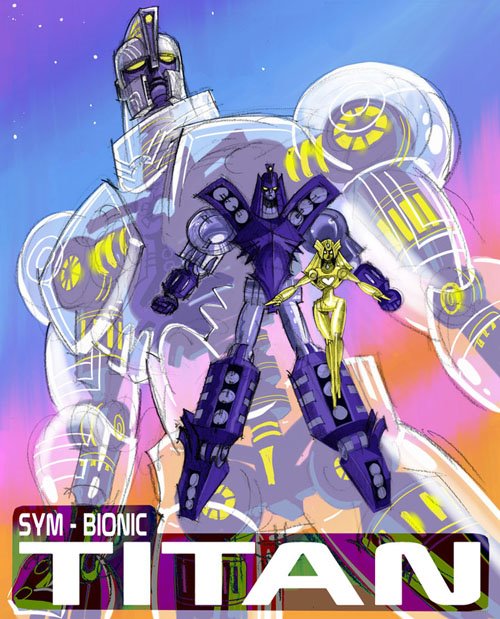
Sym-Bionic Titan


Sym-Bionic Titan is an American animated television series created by Genndy Tartakovsky for Cartoon Network.

Summary
Billed as "an exciting hybrid of high school drama and giant robot battles", Sym-Bionic Titan features "the adventures of three beings from the planet Galaluna who crash-land on Earth while attempting to escape their war-torn world." The series follows the lives of Ilana, Lance, and Octus, two alien teens and a robot in the form of humanoids who arrive on Earth, an "identical" planet to Galaluna, while fleeing an evil general who has taken over their home planet with the help of monstrous creatures called Mutraddi.

The three main characters include Ilana, princess of the royal family; Lance, a rebellious but capable soldier; and Octus, a bio-cybernetic robot, all of whom must now blend into everyday life in Sherman, Illinois. Posing as high school students, Lance and Octus work to conceal Princess Ilana from General Modula and his hideous space mutants sent to kill the sole heir of Galaluna. When called into battle, the Galalunans are outfitted with individual armor that provides more than ample protection. It's when the gravest of danger appears that Octus activates the sym-bionic defense program and he, Ilana, and Lance unite "Heart, Body and Mind" and come together to form the spectacular cyber-giant Sym-Bionic Titan.

Information from Wikipedia, the free encyclopedia